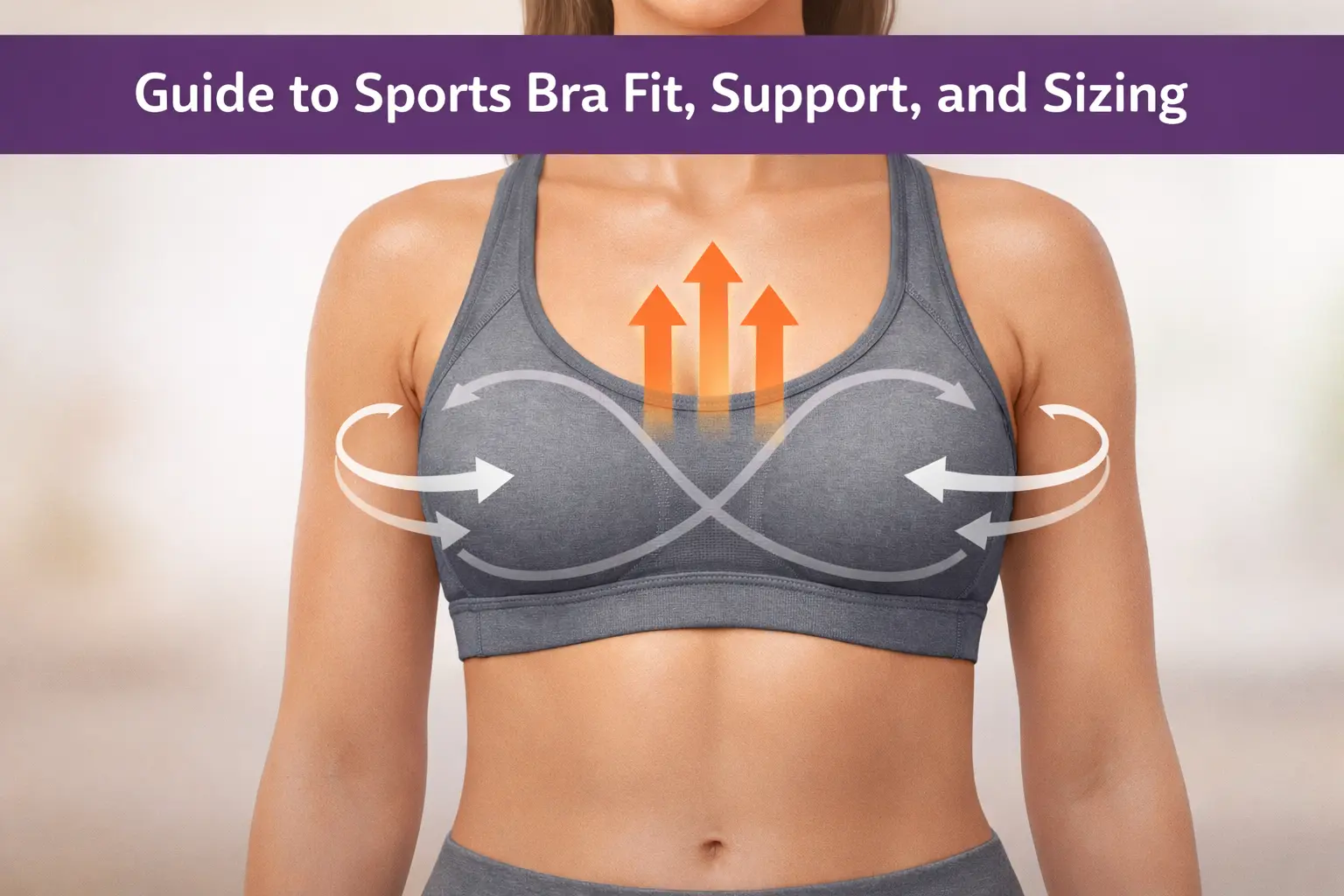
Asports bra is a type of bra designed to support the breasts during movement by reducing bounce and limiting motion in multiple directions. Unlike everyday bras, sports bras focus less on shaping and more on support distribution, stability, and comfort during physical activity. This guide will help you understand how sports bras fit, how support levels differ, and why sizing can feel confusing across styles. By the end, you will know what to look for in fit and support, and how to choose the right size with confidence.
If you are unsure about your current size, you can check your measurements using the Bra Size Calculator before comparing sports bra styles.
What Is a Sports Bra?
A sports bra is a support-focused bra style made to keep the breasts stable during movement. Its main job is not shaping or lifting, but controlling motion so the body feels secure and comfortable while moving. Sports bras are designed to reduce multi-directional movement, including up-and-down, side-to-side, and forward motion. This matters because breast tissue moves in more than one direction during activity, even during light movement.
Most sports bras use a combination of compression, structure, and stability:
Compression gently presses the breasts closer to the body to limit movement.
Structure comes from cup design, seams, or panels that guide how the breasts are held.
Stability comes from a firmer band and balanced strap support, keeping everything in place.
Because of this design, sports bras usually feel firmer than everyday bras in the same size. The band is more secure, the fabric has less give, and the overall fit is meant to stay steady during motion rather than relax against the body.
How Sports Bras Are Designed to Support Movement
Breasts do not move in just one direction. During activity, they shift simultaneously in several ways. Sports bras are built to manage this movement so the body feels supported rather than strained.
Vertical movement This is the up-and-down motion that happens when walking, jogging, or jumping. Sports bras use firmer bands and controlled stretch to limit the vertical movement of the breasts.
Side-to-side movement During running or quick turns, the breasts also move outward and inward. Wider bands, side panels, and stable strap placement help reduce this lateral motion.
Figure-eight motion In real movement, breasts often follow a figure-eight pattern that combines vertical and side motion together. This is why light support alone is not always enough. Sports bras are designed to control movement from multiple angles at once, not just from one direction.
Simple movement overview
Up and down: controlled by band firmness
Side to side: controlled by cup structure and side support
Combined motion: controlled by overall stability and fit
This multi-directional support is what makes sports bras feel different from everyday bras, even when the size label looks the same.
Key Design Features of a Sports Bra
Sports bras are built with specific features that work together to control movement and improve comfort. Each design choice affects how the bra feels, how much support it provides, and how pressure is spread across the body.
Cups
Molded cups hold a set shape and offer consistent coverage.
Soft cups adapt to the body and move more naturally.
Seamed cups use panels to guide support and improve stability.
Cup design affects containment and comfort, not just appearance.
Wire vs no wire
Wire-free sports bras rely on fabric tension and structure for support and are often more flexible.
Underwire sports bras use a wire to support each breast separately, which can feel more structured for some wearers.
Both options can be supportive when the fit is correct.
Support method
Compression presses the breasts closer to the body, reducing movement.
Encapsulation supports each breast individually using cups.
Hybrid designs combine both methods for added control.
The support method changes how the bra feels and how movement is managed.
Band construction and firmness
The band provides most of the support. Sports bras usually have:
Firmer elastic
Wider bands
Less stretch than everyday bras
A stable band helps keep the bra in place during movement.
Strap styles and adjustability
Wider straps spread pressure more evenly.
Adjustable straps allow better balance and fit.
Fixed straps feel secure but offer less customization.
Straps help with stability, but should not carry most of the weight.
Closure types
Pullover styles are simple and smooth but less adjustable.
Back closures allow fine-tuning as the band stretches over time.
Front zip styles are easier to put on and take off for some bodies.
Closure choice affects ease of wear and long-term fit.
Comfort and pressure distribution
Well-designed sports bras distribute pressure across the band, cups, and straps rather than concentrating it in one area. This helps reduce digging, chafing, and fatigue during longer wear or repeated movement.
Sports Bra Support Levels Explained
Support levels describe how much movement a sports bra is designed to control, not how tight it feels or who is “allowed” to wear it. Understanding this helps avoid both under-support and unnecessary restriction.
Low Support
Low-support sports bras reduce gentle movement but do not fully limit bounce or side motion. They work well for light movement and short wear periods, with comfort as the main goal. Low support is often described as “only for small cups,” but support needs depend on activity level, fabric firmness, and personal comfort, not cup size alone.
Medium Support
Medium-support sports bras control more motion while still allowing flexibility and ease of movement. Some medium-support bras rely on firmer fabric, while others use light structure or shaping. Both approaches can work when the band and fit are correct.
High Support
High-support sports bras limit vertical and side-to-side movement as much as possible. They often use firmer bands, wider straps, and structured cups or hybrid support methods. Cup size alone does not determine support needs. Activity intensity, breast shape, band fit, and fabric strength all play a role in how much support feels right.
Sports Bra Support Level Comparison
Support Level
Movement Control
Typical Activities
Fit Feel
Low Support
Gentle control
Stretching, walking, light movement
Soft and flexible
Medium Support
Moderate control
Cycling, hiking, and general workouts
Secure but comfortable
High Support
Maximum control
Running, jumping, high-impact activity
Firm and stable
Support level should feel appropriate for your movement, not restrictive or uncomfortable.
Types of Sports Bra by Construction
Sports bras are often grouped by how they hold and control movement. Construction affects how a sports bra feels on the body, its stability during activity, and the position of the breasts.
Compression Sports Bras
Compression sports bras use firm, stretchy fabric to press the breasts closer to the chest. This limits movement by reducing how far the breasts can shift in any direction. The shape feels flatter and more compact compared to other styles. Compression styles are often comfortable for people who prefer a close, secure feel and minimal structure. They are also common in pullover designs and tend to feel lighter and less structured.
Encapsulation Sports Bras
Encapsulation sports bras use separate cups to support each breast on its own. Instead of pressing everything inward, they guide and hold each side in place. Because each breast is supported separately, encapsulation styles usually feel more shaped and balanced. Movement control comes from structure rather than pressure.
Hybrid Sports Bras
Hybrid sports bras combine compression and encapsulation. The cups provide individual support, while firmer fabric adds overall stability. This combination can feel more secure during higher movement for some wearers.
Breast Shapes and How Sports Bras Feel on Each
Breast shape can change how a sports bra feels, even when the size is correct. The goal is not to change your shape, but to understand why certain designs feel more comfortable or more secure on your body.
Full on top
Breasts that are fuller on top may feel more pressure along the upper edge of the cups. Sports bras with good upper containment and balanced stretch tend to feel more secure without cutting in.
Full on bottom
When fullness sits lower, sports bras may feel snug at the band but lighter through the top of the cups. Styles with gentle shaping or flexible upper fabric usually feel more comfortable.
Shallow
Shallow breasts spread more across the chest wall with less forward projection. Compression styles often feel natural, while deeper cups may feel loose or wrinkled.
Projected
Projected breasts extend more forward from the body. Sports bras with individual-cup structure or hybrid support often feel more stable and reduce forward movement more effectively.
Wide-set
When breasts sit farther apart, sports bras that provide side support help guide movement inward without forcing compression. This can improve balance and comfort during motion.
Close-set
Close-set breasts may feel crowded in the center of some sports bras. Styles with smoother center panels or flexible compression often reduce pressure in this area.
Sports bras can feel different on different body shapes, but fit still starts with accurate measurements rather than changing sizes.
Sports Bra Size Chart
Sports bra size charts are meant to give a general reference.
Fabric stretch and firmness can change how a sports bra fits.
Different styles can feel different even in the same labeled size.
Because of these factors, charts are best used as a starting point rather than a final decision.
General Sports Bra Alpha-to-Band Reference
Alpha Size
Approx. Band Range
Approx. Cup Range
XS
28–30
AA–A
S
30–32
A–B
M
32–34
B–C
L
34–36
C–D
XL
36–38
D–DD
2XL
38–40
DD–DDD
3XL
40–42
DDD–G
4XL
42–44
G–H
For the most accurate fit, use the Bra Size Calculator rather than relying solely on a size chart.
Sports Bra Sizing Systems Explained
Sports bras often use different sizing systems from everyday bras, which can make labels feel confusing at first. Understanding why these systems exist helps explain why fit can vary even when sizes look the same.
Why S/M/L is common Many sports bras use S, M, and L sizing because the fabric is designed to stretch and adapt to movement. This allows one size to fit a range of band and cup combinations without needing precise cup lettering.
Why can two people fit the same alpha size? Two people may share the same alpha size even if their bra sizes differ. One person might have a smaller band and a larger cup, while another has a larger band and a smaller cup. Stretch-and-support design allows both to feel secure in the same labeled size.
Sports Bra vs Similar Bra Styles
Different bra styles are designed for different needs. Comparing them side by side helps clarify why a sports bra feels different from other bra types, even in the same size.
Uses firmer bands, supportive fabrics, and stable construction
Uses shaping, wires, or molded cups
Minimal structure with soft fabrics
Comfort
Secure during movement, may feel firmer
Comfortable for regular wear and posture
Very flexible and relaxed
Movement control
Controls vertical and side-to-side motion
Limited movement control
Little to no movement control
Each style serves a different purpose. Choosing the right one depends on how much support and stability you want during movement, not just the size label.
How to Get the Right Sports Bra Fit
Getting the right sports bra fit starts with measurements, not guessing or sizing down. A correct fit helps the bra support movement without feeling overly tight or restrictive.
Frequently Asked Questions
Can I wear a sports bra as an everyday bra?
Yes, many people do. Sports bras can be comfortable for daily wear, especially if you prefer a secure feel, but they may feel firmer than everyday bras over long hours.
Are sports bras better for your breasts?
Sports bras are helpful during movement because they reduce bounce and strain. For non-active days, they are not automatically better or worse. Comfort and proper fit matter most.
What bra type is best for everyday wear?
The best everyday bra is one that feels comfortable, supports your body, and suits your routine. Some people prefer everyday bras for shaping, while others prefer softer styles or sports bras.
Which is better, a bra or a sports bra?
Neither is better in all situations. Sports bras are designed for movement control, while everyday bras focus on posture and shaping. The better choice depends on what you are doing and how you want the bra to feel.
Why do male soccer players wear sports bras?
Male soccer players wear sports bras to hold small tracking devices that monitor heart rate, distance covered, speed, and movement during training and matches. These garments are used for performance data, not breast support.